Warranty after 2 years? Many consumers think their rights stop, but that is not true
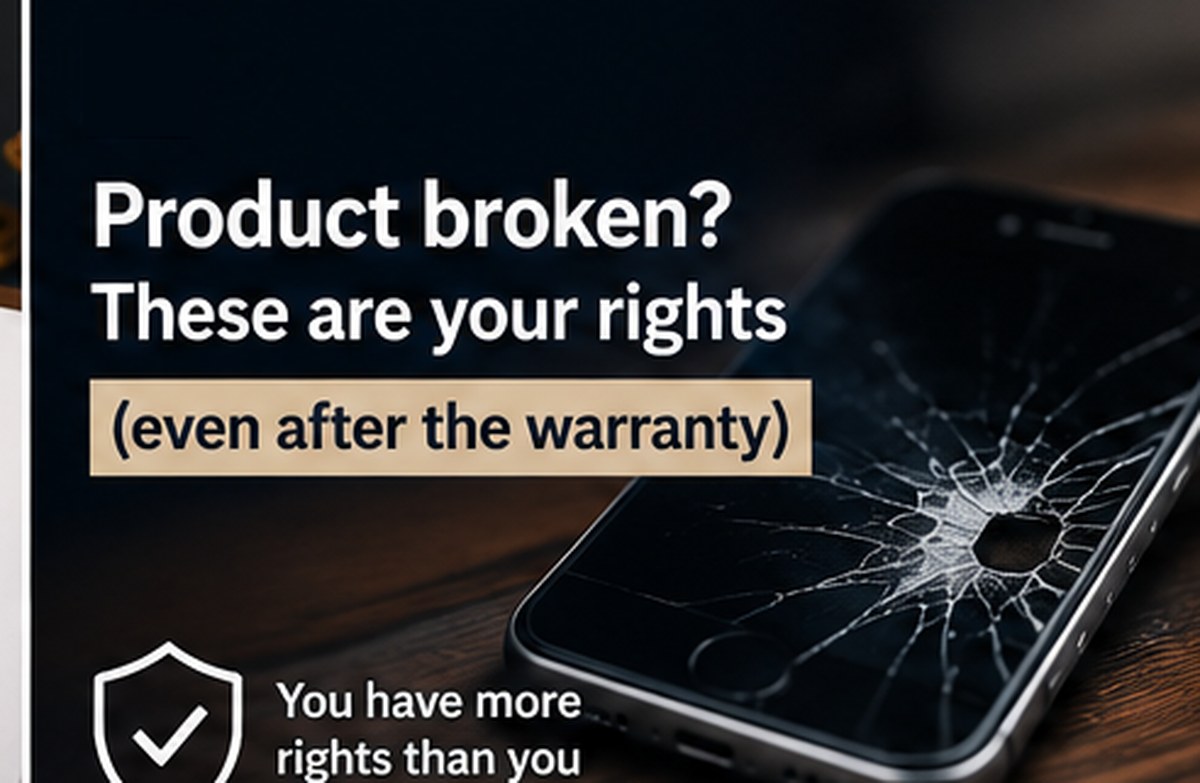
Is your product broken after 2 years? Discover why the statutory warranty often lasts longer and which rights you have to repair, replacement or a refund.
Your washing machine breaks down after three years. Your laptop stops working after two and a half years. Or your television suddenly develops serious defects. Many consumers are then told: "The warranty has expired."
But is that actually correct?
No, not always. Many consumers and businesses still believe that a fixed two-year warranty period exists. In the Netherlands that is a persistent misconception. Under the law you are entitled to a product that meets what you may reasonably expect from it. In many cases that can be longer than two years.
In this article we explain how the statutory warranty works, what your rights are and which steps you can take when a seller rejects your warranty request.
What is the statutory warranty?
The statutory warranty means that a product must do what you as a consumer may reasonably expect from it. This is also referred to as conformity.
That means, for example, that:
- a fridge should last several years;
- a television should not become defective after a short time;
- a washing machine should have a normal service life;
- a laptop should not break down quickly without a clear cause.
The law does not set a fixed term for this. The expected lifespan depends, among other things, on:
- the type of product;
- the price;
- the quality;
- what the seller promised;
- normal use by the consumer.
Is there a two-year warranty period?
No. One of the biggest misconceptions is that the statutory warranty automatically ends after two years.
The two-year period that many people know comes from a commercial warranty or from a warranty a manufacturer gives voluntarily. Those warranties come on top of your statutory rights and do not replace them. When a manufacturer's warranty expires, your statutory warranty simply continues to apply.
The Netherlands Authority for Consumers and Markets (ACM) also stresses that many consumers do not know that their statutory warranty rights often run longer than two years. For more expensive and durable products that can add up to a considerably longer period.
The seller is responsible
Many consumers are referred to the manufacturer. That is usually not correct.
For the statutory warranty, the seller is your point of contact. The seller must provide a suitable solution if the product does not meet what you were entitled to expect. Whether the seller in turn contacts the manufacturer or importer is a matter between those parties and is not a reason to send you away.
What are you entitled to?
Where there is a defect that was not caused by your own actions, depending on the situation you may be entitled to:
- free repair;
- replacement of the product;
- a price reduction;
- a (partial) refund of the purchase price.
Which solution is appropriate depends on the circumstances and the nature of the problem. Repair and replacement usually come first; if that is not possible or not reasonable, a price reduction or a refund comes into play.
May a seller charge inspection costs?
Sometimes a seller asks for inspection costs or call-out charges.
Does it turn out that the product is defective and that the fault is not yours? Then in many cases such costs may not be passed on to you. The costs of shipping or transport should in principle not end up with you either.
A practical step-by-step plan
Step 1. Collect all your documents
Keep:
- the receipt;
- the invoice;
- proof of payment;
- the warranty certificate, if you have one;
- photos or videos of the defect.
Step 2. Report the problem as soon as possible
Contact the seller, not only the manufacturer. Describe:
- the defect;
- when it occurred;
- how you used the product;
- which solution you expect.
Step 3. Give the seller a fair chance
The seller must first get the opportunity to solve the problem, for example through repair or replacement. What counts as a reasonable period depends on the type of product.
Step 4. Ask for a written response
Is your request rejected? Then ask for a written explanation in which the seller states why they believe the statutory warranty no longer applies.
Step 5. Send a formal letter
If a solution still fails to materialise, a well-founded letter can help you set out your position clearly and ask the seller to apply the statutory rules.
Real-life example
Mark buys a laptop for € 1,400. After roughly two and a half years the motherboard stops working. The shop immediately says the warranty has expired because the laptop is older than two years.
Mark points out to the seller that the statutory warranty does not automatically end after two years and asks for an assessment based on the expected lifespan of the product. He refers to the price of the laptop and to the fact that he used the device normally.
The seller reviews the complaint again and then assesses whether a free solution is appropriate.
Which laws and official guidance apply?
The rules on the statutory warranty are part of Dutch consumer law and are based on European legislation on consumer sales.
Important principles are:
- a product must conform to the agreement;
- the seller is responsible for a suitable solution;
- consumers may expect a product to have a reasonable lifespan;
- repair or replacement must take place without unnecessary costs where the consumer is not responsible for the defect.
Also read the official guidance from ACM ConsuWijzer on warranties that often last longer than two years, on the statutory warranty and the role of the seller and on the burden of proof for a broken product.
Frequently asked questions
Do I always have only two years of warranty?
No. There is no general statutory warranty period of two years. The expected lifespan of the product is what counts.
Do I have to go to the manufacturer?
Usually not. For the statutory warranty the seller is your point of contact.
May a seller charge inspection costs?
Not if it turns out that the product is defective and the fault is not yours.
How long may a repair take?
The law does not set a fixed term. The repair must take place within a reasonable time and without unnecessary inconvenience for the consumer.
What if the seller rejects my request?
Ask for a written explanation and record your own position in writing as well. That can be important if you want to take further steps.
Read more
- Warranty and subscriptions
- Broken product and the warranty
- Getting your money back from a company
- Having a legal letter written
- General frequently asked questions
- Contact Aidvocaten
Need help?
Is a seller rejecting your warranty request, or are you wrongly told that the warranty "expired after two years"?
Aidvocaten helps you with a clear and professionally drafted letter that explains your situation and refers to the relevant statutory rules. That lets you ask the seller to review your complaint again and carefully.